
The era of AI agents just went mainstream. The question is how you adopt without spooking the people who already run the place.
By Ryan Ching
Earlier this year, OpenClaw and Hermes still felt like a lab experiment most SMEs could safely ignore: interesting demos, buggy edges, and an easy place in the "watch this space" folder. That folder has closed.
OpenAI's Dots, Meta's Muse, and tools in the same family as Grok Bot are no longer niche toys. They are always-on agents with their own computers, reachable in the apps your team already lives in, and able to chip away at work while you sleep. The era of AI agents has arrived in a form ordinary businesses will actually try. The decision now is not whether agents exist; it is how you adopt them without handing the keys to a virtual server in Silicon Valley and alienating the people who still make the place run.
We said this was coming. The calendar just caught up.
Earlier in the year we wrote that organisational structures would start to change because of AI. Instead of building departmental budgets purely by headcount, firms would break work down by task: what stays human, and what an agent can own. That was a forecast, and it is no longer theoretical.
For an SME, that is the opportunity. Imagine an agent that works around the clock through the backlog of quotes, documentation, and proposal work your team always seems to have. That is not a science project so much as revenue sitting in a queue, or cost leaking out of senior people's days while they retype the same paragraph. Done well, this can be a real leg up. Done badly, it is a scary way to give up control of parts of the organisation you did not mean to outsource.
So how do you try without spooking the floor? How do you empower people to get inquisitive and experiment, instead of treating the agent as a threat or a magic button?
Treat the agent like a new hire on day one
Strip the vendor language out of the conversation. What most businesses actually want is simple: find a repetitive, time-consuming task and hand it off to an AI agent.
The easiest mental model is a new employee on their first day. You would not give a fresh hire the master passwords, the shared drive root, and the customer email list on Monday morning and walk away. You give them the information they need for the job. You train them so they understand how your business talks. You introduce them carefully, and you keep them somewhere supervised until you trust their judgement.
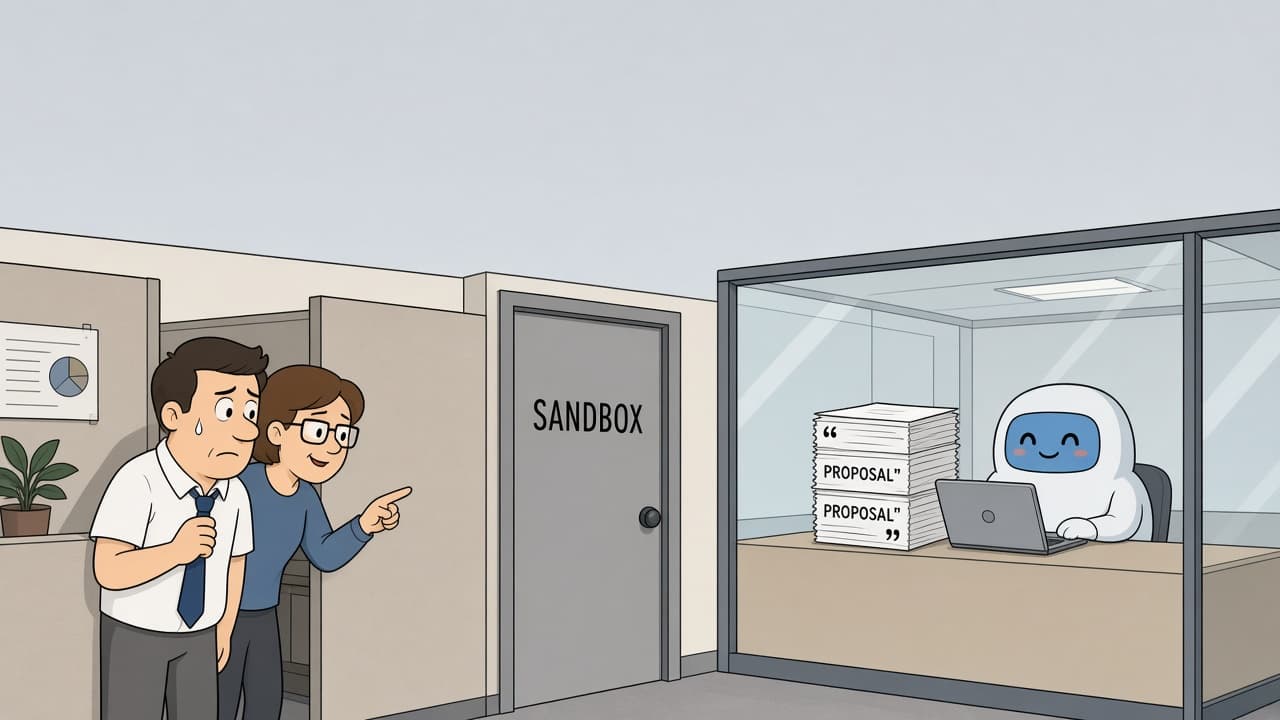
That supervised room is a sandbox. In practice, sandbox means the agent can see only the folders, systems, and examples required for one named task. It cannot send external mail until you say so, and it cannot touch accounting, payroll, or the whole CRM. It works on last month's anonymised quotes, or a staging copy of the proposal template, while a human reviews every output. You are not "doing AI transformation." You are onboarding a junior who does not sleep, and who will happily invent a confident wrong answer if you leave the door open.
Sandbox it, test it, get feedback, test it again, then run a live trial
Here is the loop I would run if this were my firm this week.
Pick one painful backlog: quotes waiting in the inbox, proposal packs that always land on the same two people, or documentation that blocks a shipment. Write down what "good" looks like in one paragraph a human already knows how to judge.
Spin the agent up in a sandbox with only that material. Have the people who own the work today review the first twenty outputs, not IT alone: the sales coordinator, the estimator, the ops lead who will catch the mistake a model will miss. Capture what broke, whether that is wrong tone, an outdated price, a missing site detail, or overconfident inventiveness.
Train again on those corrections, then test again. Only when the reviewers would be comfortable putting their name near the output do you run a live trial: real work, still with a human before anything leaves the building, still with a kill switch, and still with one owner of the review queue.
That sequence does two jobs at once. It protects the business, and it turns employees into the people who taught the agent, not the people the agent replaced. Curiosity beats fear when staff can see the sandbox, own the feedback, and decide when the live trial is ready.
What this is not
This is not a mandate to connect every app on day one because the vendor deck showed Slack and Teams. It is not a silent rollout where leadership announces that you now have agents and the floor finds out when a draft email nearly went to a customer. And it is not a headcount cut dressed up as innovation. If the backlog clears, the humans get capacity for the work that actually needs judgement, relationships, and accountability. That is the point of breaking roles into tasks.
The scary part is real, because you are letting software act inside your walls. The grown-up response is not to freeze; it is to treat the agent like a new hire, with limited access, clear training, human feedback, and then a careful live trial. The tools went mainstream this week, which means your sandbox can start on Monday.
If you want help picking the first task and locking the room before anything gets keys, you know where we are.
Ready to use the 3 Peat AI Framework Builder?
Use the 3 Peat AI Framework Builder to list your AI systems, classify risk, and generate a practical governance framework your team can implement immediately.
3 Peat AI Framework Builder