
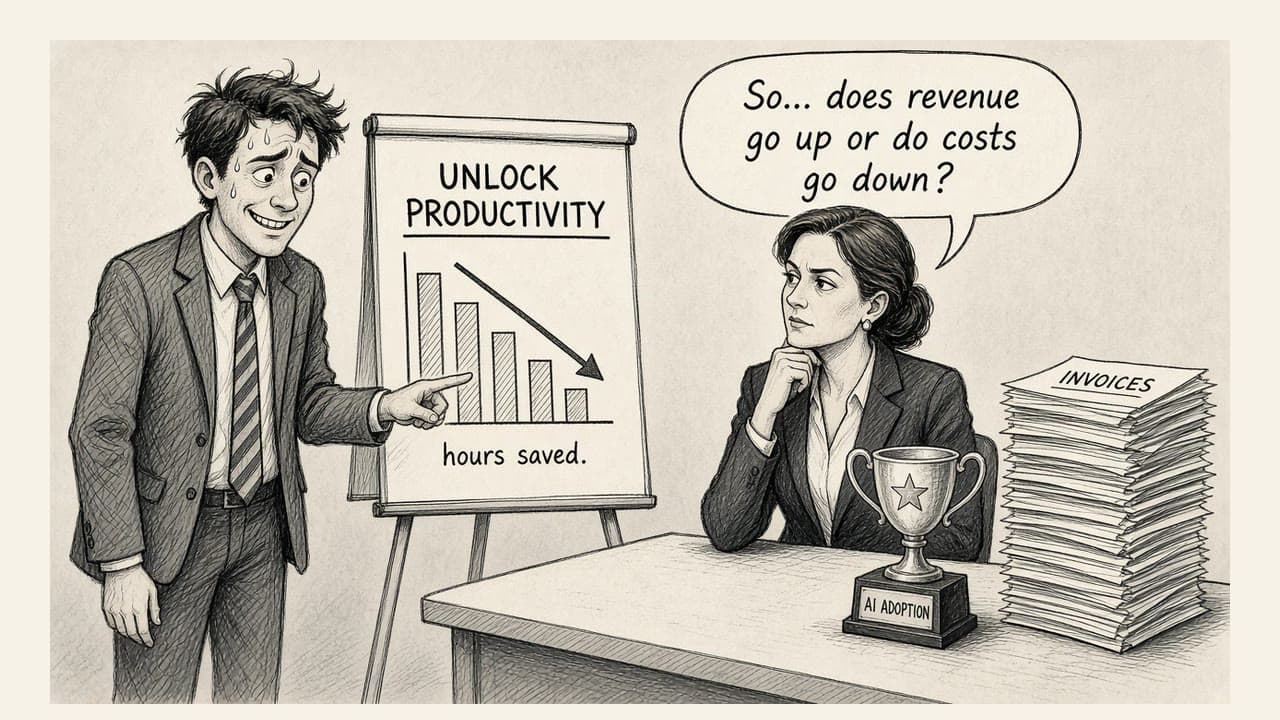
Treasury just said most Australian businesses use AI. Almost none of them changed how the place actually runs.
By Ryan Ching
I was on a call last month with a mid-sized owner who swore his business was "already on AI." He wasn't lying. Half the sales team had ChatGPT open. Someone had bought Copilot seats. The ops manager had a Canva magic-write story. When I asked which process looked different on a Thursday afternoon compared with a year ago, the room went quiet.
Treasury has a name for that room. In late August they told the Treasurer that around two-thirds of Australian businesses report some AI adoption, but less than 10 percent report significant adoption. Widespread, but shallow. Access is not the problem. Changing how the place actually runs is.
If you are in that two-thirds, you are not behind. You are normal. The question is whether normal is enough when a competitor stops doing one painful job by hand.
The bit we tell clients that consultants usually won't
At 3 Peat we have learned something the hard way, and I would rather say it out loud than dress it up. Pure efficiency projects rarely get a callback.
You can show someone a tidy demo of hours saved, a nicer inbox, a slightly faster admin loop. They nod. They say it is interesting. Then procurement goes quiet, and you never hear from them again. Efficiency is real. It just does not move the buying conversation on its own.
What gets traction is simpler, and a bit blunter. Can you show, in language a managing director will repeat at the next board coffee, that the AI initiative will either:
(a) increase revenues, or
(b) reduce costs.
Not "unlock productivity." Not "modernise the stack." Revenue up, or cost down. Preferably with a before and after that fits on one slide.
That sounds obvious until you sit in the meetings. Most AI pitches still sell capability. Owners buy outcomes. If you cannot put the project on one of those two rails, you are probably selling a nicer way to stay in the shallow two-thirds.
What "not shallow" looks like on a sales floor
Here is a concrete example we keep coming back to, because it passes the test.
Most sales teams still burn a stupid amount of senior time on standard customer and prospect queries. Lead times. Spec sheets. "Do you ship to X?" "What's the MOQ?" "Can you match this quote?" The questions are real. The answers are usually already in a price book, a FAQ, a CRM note, or the brain of the person who has been there fifteen years. The cost is that your closers become a helpdesk before lunch.
Put an AI agent on that first line. Not a chatbot that shrugs and says "contact sales." An agent that can answer the standard CS and sales queries from approved knowledge, escalate the weird ones, and log what it did. Suddenly the humans are not typing the same paragraph forty times a week. They are on the opportunities that actually convert.
That is both rails at once if you measure it properly. Cost down, because you stop paying conversion talent to do FAQ duty. Revenue up, because those same people get hours back for follow-ups, site visits, and the deals that were dying in the inbox queue.
The shallow version of the same idea is a free ChatGPT tab and a shared Google Doc of "suggested replies." It feels modern for a fortnight. Then nobody owns the answers, the pricing drifts, and you are still in Treasury's two-thirds.
One process. One number. Then decide.
If I were running your firm this week, I would not buy another seat. I would pick one job that is either blocking revenue or quietly burning cash. Standard inbound sales queries are a good candidate. So is quote turnaround. So is the weekly chase of overdue invoices, if that is where the money leaks.
Write down the current baseline. How many standard queries hit the team each week. How long each one takes. How many opportunities go cold while someone is stuck answering them. Then run the agent on that lane with a human in front of anything that leaves the building. Measure again in thirty days.
If revenue did not move and costs did not move, kill it. Do not expand it into a transformation programme because the vendor deck looked clean. If one of the two numbers moved, you have left the shallow bucket. That is the whole game.
Treasury is not wrong about Australia. Plenty of firms have AI. Almost none have changed the Thursday afternoon. The ones who will pull ahead are not the ones with the most tools. They are the ones who can answer, without flinching, whether the thing they installed made more money or spent less of it.
If you want a grown-up look at which sales or CS query lane is worth putting an agent on first, you know where we are.
Ready to use the 3 Peat AI Framework Builder?
Use the 3 Peat AI Framework Builder to list your AI systems, classify risk, and generate a practical governance framework your team can implement immediately.
3 Peat AI Framework Builder